Unfortunately, four weeks ago a co-worker in my room resigned and took a new position elsewhere. A casual unqualified teacher has come in to cover this position temporarily, but I am hoping she will become long term. She just seems to have a natural disposition to care and respect our young children, but after a couple of days with us I could sense her feeling stressed. It was a rough introduction for her as we have had four young children start nursery in a very short space of time. R. mentioned that she wanted to have a quick catch up, so we found a quiet space in the day when we could pop out of the room. She aired her concerns with me, and I must admit that I had also been feeling really stressed and that I couldn't give my children the quality time I know they all deserve. But it would be so easy for me to just give in and have a good ol' moan and whine about it ( I know I felt like it). Instead, I took the pro-active approach of 'this is the situation we are in, these are the children and they are here now. What can we as the adults do to control the situation a bit more'. I acknowledged R's concerns, and valued that she could speak with me so openly. Together we talked through some strategies, which included changing our planning. Our focus has been 'The impact I have on the world around me'. By acknowledging and responding to our new babies needs, we are showing them that they are valued and that they have an impact on us - while in nursery, we are their world. I also introduced R. to bubbles of care. Whilst she is in the middle of a care routine - feeding, nappies, settling, the other staff are available to interact with the other children. I suggested we try and reinforce a 'baby area', a section of the room where the younger babies can be with an adult, interacting with each other and appropriate equipment - a safe place.
After consultation with the centre manager, I also spoke to the head teacher of nursery two about releasing the 7th member of staff (float position), allowing her to come into nursery one during our busier moments and to help support during lunch time.
Hopefully by putting these techniques into action we are able to create a calmer, more relaxing environment for us all.
This is an example of dimension 23 - demonstrating flexibility and adaptability, and dimension 24 - focusing on teaching and learning. It is all about the children, and by responding to their needs they are learning that they will be heard and respected. It was also an opportunity for me to lead and support other teachers - dimension 25.
Sunday, June 17, 2012

Saturday, June 9, 2012
Reflection of the December observation video
I know it has taken a while, but after watching it a few times I have reflected on the video of me and the flour exploration that took place last December, 2012.
I think this video was good for me to see, as I do find it uncomfortable to watch myself. I always seem to see all the faults, things I don't like, but I know this activity was right for this group of children. It was following on from a similar activity the previous day with flour on trays at the table, and I thought directly onto the table would be a good idea. I sat down at the children's level as I shared out the flour. By using the one scoop, I was able to model sharing, rather than a separate scoop for each serve. It possibly wasn't obvious to the children, but I like to add those little touches, just in case they are noticed.
I began to model circular movements in the flour, and some children began to imitate, while one child just observed me. As a child patted their flour, I then became the imitator, reinforcing the action they chose to do. One child in particular seemed more interested in moving her chair, and so I redirected her back to the activity, adapting the activity by encouraging her to manipulate the flour on the floor in a similar way that we used our hands.
Charlotte began to get upset as I walked past her, so I was able to reposition my self to be nearer both her and the child that was moving the chair. I was really pleased with the amount of time she spent at the activity - when she first began with us, Charlotte appeared to not be very comfortable participating in any group activities, let alone a messy activity. So by joining in with flour play shows how far she has developed. She was ready for a sleep, so my colleague was able help by readying her for bed so that I could continue to finish up the activity. As the children removed themselves from the table, I was ready with a face cloth that I could offer, allowing them the opportunity to respond by holding out their hands.
In the background of the video, the vacuum cleaner could be seen. I had made sure all resources needed were ready before we began. After the video had ended, I plugged in the vacuum to clean up the flour and this was the beginning of another great activity. Some children who decided not to explore the flour decided that they would like to help use the vacuum. I believe that children should have the choice whether they want to participate or not, as they are not all interested in the same things. By having this divided into two activities, different interests were catered for, showing that I am able to recognise and support diversity among groups and individuals. It also displays ethical behaviour and responsibility; respecting the rights and choices of the individual children.
Monday, April 16, 2012
Recommendation
17th April 2012
Statement of Recommendation
To whom it may concern
Rebecca Goh undertook an induction and mentoring programme under my guidance as of the 31 May 2010 working in her capacity as a Provisionally Registered Teacher.
Through this period of support, Rebecca has gathered evidence of the progress being made towards meeting the standard for full registration. This is by way of anecdotal observations, examples of work in practice, and reflections. As Rebecca’s mentor, I have conducted formal observations, had both formal and informal discussions in regards to practice and provided feedback on the practice I have observed. Rebecca has during this time been assessed against the criteria specified by the Teachers Council.
During this time Rebecca has been able to develop and adapt professional and effective teaching practices, knowledge and relationships for meeting the needs of the Centre, children and whanau.
I hereby endorse Rebecca for the period of time detailed above.
Regards
Joann Radford
Reg number: 260036
Centre Manager
Natural Steps Ellerslie
75 Ballarat St, Ellerslie
Auckland 1051
Wednesday, April 4, 2012
Childspace conference, Wellington
On the 23rd of March I was fortunate enough to be able to fly to Wellington to attend the 'Yeah Baby' conference, run by Childspace. I was asked to write an insert for our newsletter to share some of my experiences with our parents.


As well as with the parents, I have the responsibility to share my new knowledge with my team. I was able to participate in three workshops - Rosters and rhythms don't mix
- Aspiring to co-create an authentic Aotearoa-centric bicultural curriculum in infant and toddler educare
- Respectful care is only fair
The first thing I did was to just give a brief run-down of the main ideas I got that would compliment our nursery room - 'care clusters', and 'bubbles of care'. Care clusters is about doing a group of care tasks during the same moment. Eg: checking a nappy, then a meal time, or nappy and then bedtime. By associating more than one routine together, we spend less moments interrupting what the children are busy doing. Bubbles of care is a term that I really connected with. When a carer is with their child during a special moment, such as feeding, they should only be with that child - in their bubble. This means an uninterrupted moment dedicated to the child or group of children with the other adults within the room taking account of everything else that is happening around them . This is a technique that requires real teamwork. It is also something that other staff need to respect when they come into our room. It shows a real respect for the children, that we value our special moments together, and involves them in their care routines - with not to. I felt that one of the easiest ways to incorporate the different ideas from the conference was to add them to our planning - basically planning for the adults rather than the children.
This was a great opportunity for me to encourage others and to participate in professional development (dimension 28), and for me to lead and support other teachers (dimension 25).
*scan copy of planning (note for me)
Documenting planning part 2
Since January 2012, I have taken over the role as room leader in Nursery One. One new aspect I have introduced has been the new format of documenting our planning. Because I have two co-workers who, in the scheme of things, are relatively new to the profession (both are still in training, hopefully beginning their third year soon) and I know this format has worked well with me and others, I thought it could help us as a team to be consistent. I explained how I felt it was really important that children, especially the under twos, need to be provided with lots of opportunities to practise new skills that they are developing, and I always feel really stink when we have a cool activity for them, but the next day it's gone and some will miss out on rehearsing what they have experienced. Allie and Ksenia both agreed, saying that with our part-time children, they sometimes don't even the chance to experience things for the first time. So we were all in agreement that we would allow an activity/ set of resources to be available over a whole week, if not longer.


Now that the form has been in action for a few months, we're all getting the hang of making any notes, observations, ideas, children who participated in, etc directly onto the form. They are very easy to use, and very time efficient as we don't need to wait for some time to type things up formally. Plus, when we have release time, there is a whole stock of notes for us to use for individual and group stories. Our displays on the walls have been able to change as well. Instead of overstocking the wall with learning stories, we are displaying large photos of the children in action. A lot more parents are stopping to just look and comment on what they are seeing. Even the children are approaching the walls, looking at the photos and pointing. I wonder if they are recognising themselves, familiar people, or if they are recognising things that they can recall doing themselves. Either way, it is really reassuring to see the children acknowledging our displays in such a positive way.
By repeating experiences with the children, I am demonstrating knowledge of appropriate teaching objectives (dimension 04), and by being able to easily link the planning documentation to our daily journals and learning stories, I am establishing high expectations which value and promote learning (dimension 08). I am also helping to manage student learning processes through providing opportunities for children to build on their experiences (dimension 09).


Monday, March 26, 2012
Becoming an associate teacher

I have become Allie's associate teacher as she continues her studies towards getting her degree. As a role that is new to me, I thought it would be a wise idea to participate in any workshops that are available. The first that I have attended was "giving constructive feedback". By going to this, I am demonstrating how I lead and support other teachers, dimension #25.
Sunday, February 19, 2012
Feedback to students
When teaching, students require feedback. When teaching young children, I provide feedback immediately. This is often something simple such as when a baby looks at me I smile in response, or redirect/ reposition babies when needed. If they are upset, I acknowledge them and then provide what is needed, such as nappy change, a bottle, bed, or even just a cuddle.
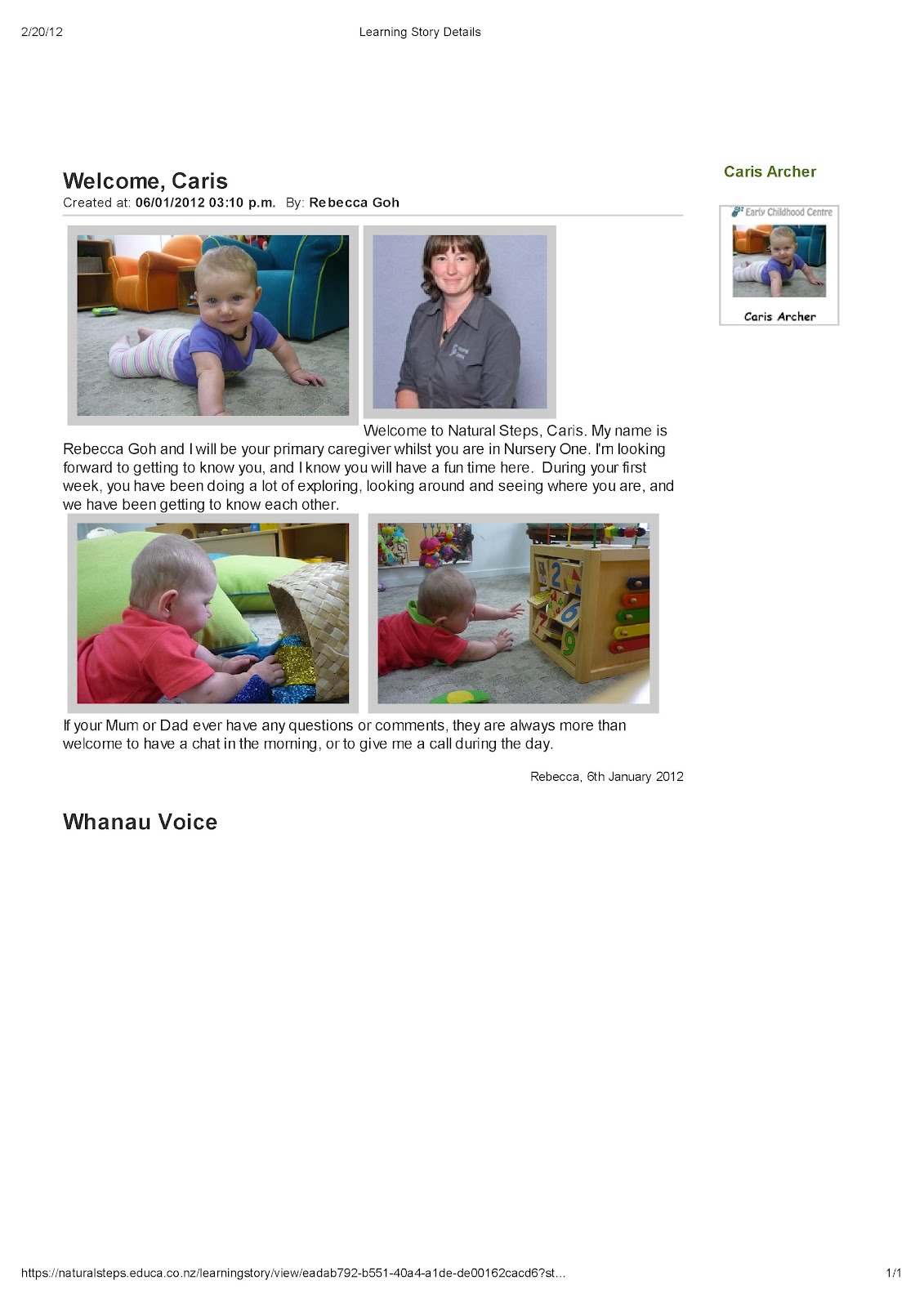
When Caris first joined us at Natural Steps, I spent some time with her, helping to settle her in so she knew that she could trust her needs would be met. The only real way she learnt this was by having appropriate responses, or feedback. It is through this feedback that communication has opened up between us, and I now get the most wonderful smiles in the mornings when she arrives.
Use of technology
Technology is the making, usage, and knowledge of tools, machines, techniques, crafts, systems or methods of organization in order to solve a problem or perform a specific function - http://en.wikipedia.org/wiki/Technology, or simply put, technology is the creation of something that serves to meet a need.
In my nursery room, we work using Pikler's theories, which have been incorporated into the RIE philosophy. The key word to sum up these ideas is 'Respect'. As a result, the 'technology' used is age and stage appropriate equipment. The children are provided with an environment where they are invited to participate if they choose to do so. When we have an activity at the table (such as painting or play-dough), they are able to independently come and join in. In order to make this possible, we don't have high-chairs. Instead, low chairs that the children can get themselves into and out of are used. We also use bowls placed on sheeting on the floor for gloop or water play. This way, all children are able to come and go as they wish, and are able to observe what is happening.
Not all technology is computer based. For under two's, I feel very strongly that technology should aid the inclusion of all children, and this is what the child sized equipment does.
Now that the centre has Educa up and running, we are able to include video clips onto the website for parents to see their child in action, not just photographs.
There are many different forms of technology, and they all have a different purpose and a different audience. I feel that I am able to use these different forms appropriately, and they help everyone involved.
Sunday, January 1, 2012
linking of learning stories
Through noticing Isaac, planning around the idea that he had and then continuing to build on his knowledge and linking learning stories, I am demonstrating Professional Knowledge dimension 3, the characteristics and progress of my students. My colleague and I also worked together to extend the water play by creating gloop. I worked alongside Allie, leading and supporting her. As a result, we were able to use the activity she had set up as our room's blog. This was an example of my professional leadership, leading and supporting other teachers (dimension 25).
Impromptu water play
By: Rebecca Goh


Wednesday, December 28, 2011
Dec Observation Video
Kia ora,
I have uploaded the short video of you taken as you interact with children within your room. For the purpose of teacher reg, can you please watch the video and comment on several areas of your practice that you liked or were pleased about. And then comment if there you were able to observe any practice that you would change next time or would like to work towards improving.
Self reflection through video is a great way to objectively view your own practice as others see you.
You may also like to get a colleague to watch the video and see if their reflections mirror or are different to your own.
thanks
Joann Radford
Sunday, December 18, 2011
Reading for your perusal
Afternoon Rebecca,
Below is a link that takes you to a cluster of readings on a web page called:
Teachers Work: growing through critical reflection and action.
Reading in '2011 - Volume Eight: Issue One that may be of interest to you include:
An-other Look at Assessment: Assessment in Learning KERRY EARL AND DAVID GILES
This article seeks to review understandings of educational assessment as revealed in the phrases teachers use (assessment of learning, assessment for learning and assessment as learning). We propose a reconsideration of what teachers might have taken for granted in these phrases and assessment practice. We suggest that along with assessment knowledge and skills, teachers need a way of ‘being in’ assessment ...
http://www.teacherswork.ac.nz/journal/volume8_issue1/earl.pdf
Professional Dialogue as Professional Learning ANNE GREY
This article discusses professional dialogue as an important aspect of professionalism for early childhood teachers. It draws on the experiences of four qualified early childhood teachers of one teaching team in an early childhood centre who engaged in extensive professional dialogue with each other. Dialogue focused on the values that underpinned and were reflected in their teaching practice. These values were discussed in order to explore the commonalities and differences in teaching philosophies amongst the team ...
http://www.teacherswork.ac.nz/journal/volume8_issue1/grey.pdf
Effective Educative Mentoring Skills: A Collaborative Effort LYN McDONALD AND ANNALINE FLINTTeacher induction programmes provide critical support for new teachers moving into teaching. The focus of this paper is to examine and identify the specific understandings, attitudes and skills educative mentors require in supporting Provisionally Registered Teachers’ (PRTs) learning .
http://www.teacherswork.ac.nz/journal/volume8_issue1/mcdonald.pdf
Happy reading-
Joann
Wednesday, December 14, 2011
December Teacher Registration Meeting.
Morena Rebecca,
Thank you for taking the time to sit and assess your progess so far, in working towards gaining your full Registration.
Rebecca, to date you have meet 2/3 of the goals, today have identified how you have or could further achieve and/or provide documentation that meets the rest of your goals. Those areas yet to be covered include:
kia Ora
Joann
Thank you for taking the time to sit and assess your progess so far, in working towards gaining your full Registration.
Rebecca, to date you have meet 2/3 of the goals, today have identified how you have or could further achieve and/or provide documentation that meets the rest of your goals. Those areas yet to be covered include:
- 3
- 5
- 8
- 9
- 15
- 18
- 22
- 26
- 27 &
- 28
Looking forward, we discussed that you feel that you need to be more consistant with your entries- rather than attacking it in 'bursts' as you currently do. I will be observing you before xmas, and trying to add a range of methods to capture you in practice such as videos, photos and formal observation.
Keep up the great work Rebecca, you are an inspirational teacher, who shows authentic empathy and passion for children.
kia Ora
Joann
Sunday, November 20, 2011
Incident form
Within each class at Natural Steps, we keep records every day for nappy changes, sleep check sheets, food and bottles, and we also have accident/incident forms. At the beginning of each week (and every morning in the case of the sleep check sheet) I fill in the children's names on the new forms and file away the previous forms. These forms are kept in a folder on nursery one's shelf for three months, after which they are discarded. The accident forms however, are treated differently. Usually it is the head teacher of the room that handles these, but as this wasn't being done regularly, I offered to take on that responsibility. At the end of each calender month, the accident forms are collected and the totals of type and adult involved are tallied. If there is anything that requires attention, it is discussed with the office and staff members concerned. Otherwise these are filed in the office.
There was one incident that I came across that concerned me. I noticed that there were two copies of an incident involving a child during their nappy change, and neither had been signed by a parent of the child. I brought this up with the centre manager, and informed her that I would speak to the parent concerned. I thought just in case this needed to be discuss further she should know I would be speaking with A's parents. When I informed the parent in the morning, he seemed surprised and had no idea at all. All I could do was apologise, explain how the incident form process should work, and reassure that it wouldn't happen again. I also put a note in his daily diary just so we had it in writing.
I was really disappointed to see what I viewed as lack of respect for the child and their parents. Even if only a minor thing, parents should always be informed. We are caring for their children, and they expect nothing but the best from us - always. I did inform my head teacher when she returned to work the next day, letting her know that when I found the two forms, I spoke to the parents.
By taking on the role of tallying and filing the forms, I meeting dimension 18,Professional Relationships - maintains accurate records.
I am also meeting dimension 22, Professional Relationships - maintains confidentiality, trust and respect. By informing the parents that I had come across this incident form they hadn't seen, I am demonstrating my respect for them. I spoke privately with them, maintaining confidentiality, and explained what the correct procedure should have been. I am trying to build a trusting relationship between us.
Wednesday, September 28, 2011
Easy communication with parents
Because we have recently changed the carrier of our online profile books, as soon as we post an entry, the parents get an email informing them. When I wrote the farewell page for Isaac, I was really pleased to get a response from his mum. I found it up lifting, knowing that she does look at the entries put on. You can't help but wonder sometimes if all your hard work is even seen. Now I know - it is.
 This is evidence of dimension #19. communicates with families, whanau and caregivers. It is also evidence of dimension #20. contributes to the life of the learning centre, as our centre functions best when there is communication that happens both ways between the parents and the staff - especially the primary caregiver.
Tuesday, September 27, 2011
Change of primary care for a transitioning child
One of my primary care children is transitioning to nursery 2. When he first began in nursery one, he was a very sensitive boy. He had trouble settling down to sleep, refused to eat, and unless I was with him, was very unsettled. During our time together he has grown in confidence, would call out to anyone just to get them to look at him so that he would laugh and wave at them. The changes in him were amazing.
Now that he has moved over to nursery 2, I can see those personality traits returning. I have discussed with his new primary caregiver how this young boy was when he first began with me, and techniques she could try with him, but above all, how much he requires patience, care, and to be listened to. When I went outside today (September 28th), I was able to model for her what I meant. She mentioned that she found it easier to just let him be and to give him space. I agreed that, yes, he does require space, but he also needs clear boundaries. An example of this was when he left the sandpit, he carried the spade with him and then began to walk inside with it. His new caregiver seemed as if she wasn't sure how she should respond to this behaviour. I repeated to her that as well as allowing him space, he does need to learn the expected boundaries. I then modelled to her my explaining to the young boy that the spade stays in the sand pit, and that he needed to take it back. This was happily done. I reminded my colleague that because I was the former primary caregiver, we had formed a friendship. All it would take was for her to be consistent, to listen to him, and just a little bit of time and she would have the same with him. And if she's ever not sure of what to do, to just listen to him and he would tell her in his own way. Through this interaction, I was demonstration how I lead and support other teachers, dimension #25.
Documenting planning
As a team, the nursery one staff discussed our planning wall and the next steps (and the possibility of changing our approach to displaying it). One suggestion I had made was to implement a new format to the way we documented our group activities. It was an example I had seen in action when I worked at a nursery school in London, and I felt that it worked really well for getting information and observational notes written down quickly and efficiently. At the top of the front page we could write what the intended learning outcome is, and at the bottom, we evaluate the session and write what the next step is. The form was designed in A4, and was four pages as it was intended to use over four sessions. This way, the activity was able to be either continued over four consecutive days, or else extended over the four days. I sometimes find that we set up an activity one day, but the next it has gone and something else has replaced it. I am of the opinion that if we introduce something (a resource, a set of skills required, a game, etc) then we also need to provide plenty of opportunities for those skills to be rehearsed over and over).
I will look through my storage boxes at home for an example of it, otherwise I will recreate the form to introduce to my team, see what they think, and alter it to best meet our needs.
Tuesday, September 20, 2011
Being with babies
An excert about interactions with babies-in particular the pikler and RIE approaches.
Babies have a marvelous affect on us. They enchant us. They touch us very profoundly.... And yet... many times it happens that in the important moments of being together we do not really pay attention to them, because we are preoccupied with the tasks relating to them: putting on their shirts, wiping their bottoms, adjusting their diapers. We touch them, move them around, and sometimes fail to notice the expectation in their gaze as they look at us." This view is expressed by Anna Tardos from the Pikler Institute in Budapest, Hungary, in her Exchange article, "Being with Babies." She continues...
"We don’t think about how happy they would be ‘to help’ if we had a discussion with them in the meantime, and if we told them what we were up to:
"'Now, I am going to take off your diaper to see if there is anything in it. I am going to wipe your skin, lift your bottom. Will you allow me to do that? Now, I am going to put this coat on you. You see how pretty it is? Your grandmother made it for you. First I am pulling up on one arm, then the other. I have to lift you up a little bit. It’s not very easy, but we have made it.'
"Would they help? Yes. The baby would pay attention to what we are doing, would relax his arms, and, at the age of only a few months, he would reach his arms towards us when we show him the shirt. A real conversation can be formed this way between the adult and the baby. In this way, the hasty and careless movements that often cast a shadow on the joint activity during times spent together could be avoided: legs lifted too high, too swiftly being turned on the side, the baby&rsqu o;s arm getting stuck in the sleeve, or legs stuck in the zippered (not very practical) overalls. This can be a very unpleasant experience for the baby. And it also happens that, instead of a rich and meaningful dialogue realized in the course of the pleasure of being together, the adult must dress a crying and protesting baby. At this time, the adult would try to calm the baby down: 'I can see that you are tired. Alright, I am going to hurry, and we’re going to be done real soon.' Meanwhile, the movements become even faster, and quite often overhasty, thus even more unpleasant for the child. It’s a shame. Why? Because the activity of getting dressed or changed, repeated several times a day, can also be a joyful encounter of being together!"
Joann
Saturday, August 27, 2011
Leadership
Morning Rebecca,
Leadership... not only tricky to define but also to work towards. Leadership when effective can take on many possbilities, open many doors and empower teams and teachers to work together to achieve amazing outcomes for teams, children and families.
Im sure that you have read lots about Leadership and have also in your teaching career come across a range of leadership styles(some effective and sadly others detrimental).
Below is an excert about the benefits of collaborative leadership- enjoy.
A recent issue of the Harvard Business Review (July 2011) focused on "collaboration." In discussing how life for a collaborative manager is different, the magazine noted...
"In the old world of silos and solo players, leaders had access to everything they needed under one roof, and a command-and-control style served them well. But things have changed: The world has become much more interconnected, and if executives don't know how to tap into the power of those connections, they'll be left behind.
"Leaders today must be able to harness ideas, people and resources from across boundaries of all kinds. That requires reinventing their talent strategies and building strong connections both inside and outside their organizations. To get all the disparate players to work together effectively, they also need to know when to wield influence rather than authority to move things forward, and when to halt unproductive discussions, squash politicking, and make final calls.
"Differences in convictions, cultural values, and operating norms inevitably add complexity to collaborative efforts. But they also make them richer, more innovative, and more valuable. Getting that value is the heart of collaborative leadership."
Wednesday, August 10, 2011
Transitions
Morning,
Below is a snippet from an article on transitions, and the effect they can have on the classroom and childrens ability to follow through and develop interests. happy reading.....
Joann
In their Exchange article, "Eliminating Transitions," which forms the basis for the newest Out of the Box Training Kit, Barb Gallick and Lisa Lee make a case for keeping to a minimum the number of transitions children confront in early childhood classrooms:
"Picture a group of children in the block area who have spent 15 or 20 minutes building an elaborate car wash. They have just gotten to the point where they will be using cars to develop a story and act it out when the teacher says it’s time to clean up for snack. Of course, after snack there’s group time and then the class will be heading outside. Are these children also wishing that they could have had an extended time to relax and focus on enjoying their car wash and the dramatic play possibilities? Do they also feel like they have no control over their schedule?
"Having a daily schedule that creates routines for young children is an essential part of an early childhood classroom. Evaluating the daily schedule on a regular basis is an integral part of creating a quality program that meets the needs of both the children and adults who ‘live’ in the classroom each day. We would suggest that you look (with a critical eye) at your daily schedule once a year to determine whether it works for the group of children currently enrolled in your classroom. One of the most important things to consider when reviewing your schedule is the number of transitions that occur throughout the day.
"Transitions tend to be some of the most difficult and stressful moments in an early childhood classroom. At these times teachers often find themselves dealing with more challenging behavior s and feeling more like police officers than nurturing caregivers. If you are feeling uncomfortable or frustrated during transition times, that is a sign that your current schedule may need to be revised to better meet the needs and developmental levels of the children in your care."
Tuesday, April 5, 2011
How do we communicate with children

Just a quick quote that relates to the importance of conversation- authentic conversations with children on a daily basis- by adults that are genuinely interested in listening to the 'childs voice'.
Have a read... Any thoughts?
Jim Greenman- What kind of place for childcare in the 21st Century.
"Perhaps the quickest and most fundamental evaluation of a child care setting is to observe the quantity and quality of conversation. To note whether adults are listening to children, provoking the ideas of children, and offering a child one of their most precious gifts — undivided attention and their full human presence. How can this occur with real world rat ios and group sizes and all the daily demands of care? It can only happen in environments that support teachers and are well designed and prepared for independent use by children. And how would the environment change if designed for conversation? Perhaps with acoustics and places that lend themselves to conversation: couches, benches under a tree, a seat that puts the infant right there for all the murmurs and reassuring words."
Subscribe to:
Posts (Atom)